VST3 · Audio Unit · Mac & Windows

Lift any sound from any record.
Play it back on your keyboard.

Mimic separates a track into stems, analyses the timbre of the sound you choose, and rebuilds it as a real, playable instrument on a MIDI keyboard. Stem separators do half the job. AI synthesizers do the other half. Mimic is the first plugin built to do both.

Coming v1.0 · Q3 2026 Built in JUCE / C++ On-device · no cloud upload Try the live demo below
In development · v1.0 coming Q3 2026
Stage 2 / 4 · AI timbral matching
MIMIC
V0.1 · CONCEPT
120 BPM  ·  32 VOICES  ·  44.1 KHZ  ·  PRESET INIT
L
-∞ dB
Active Patch
— No patch loaded —
R
-∞ dB
1Load Source
2Pick a Stem
3AI Generates
4Play
Envelope · ADSR
Attack
0.01
Decay
0.20
Sustain
0.70
Release
0.60
Filter
Effects
ENGINE · TONE.JS
TARGET · JUCE / C++
BUILD · v0.1 CONCEPT
MOD
CC1
EXP
CC11
How it works

From any track to a playable instrument in seconds.

Mimic runs three engineering stages back-to-back. The web demo above mirrors them step-for-step — the shipping plugin runs them natively in your DAW with sub-millisecond latency.

STAGE 01

AI Stem Separation

Drop in a track, paste a streaming link, or capture audio from your DAW. Mimic's separation engine — built on Facebook's MIT-licensed Demucs Hybrid Transformer — splits the signal into clean drums, bass, synth/keys and vocal stems on your machine. No cloud upload required.

› load track.mp3 .................. OK
› split 4 stems (Demucs HT-v4) .... OK
› energy + transient map .......... OK
STAGE 02

Timbral Analysis

Pick the element you want — a bassline, a synth pad, a vocal "ahh". Mimic extracts a fingerprint of its spectral content (MFCC, chroma, centroid, bandwidth) and a custom neural model maps that fingerprint into our synthesizer's parameter space. It produces four candidate patches per query.

› extract spectral fingerprint .... OK
› query timbral embedding model ... OK
› rank candidates (cosine sim) .... OK
STAGE 03

Playable Synth Engine

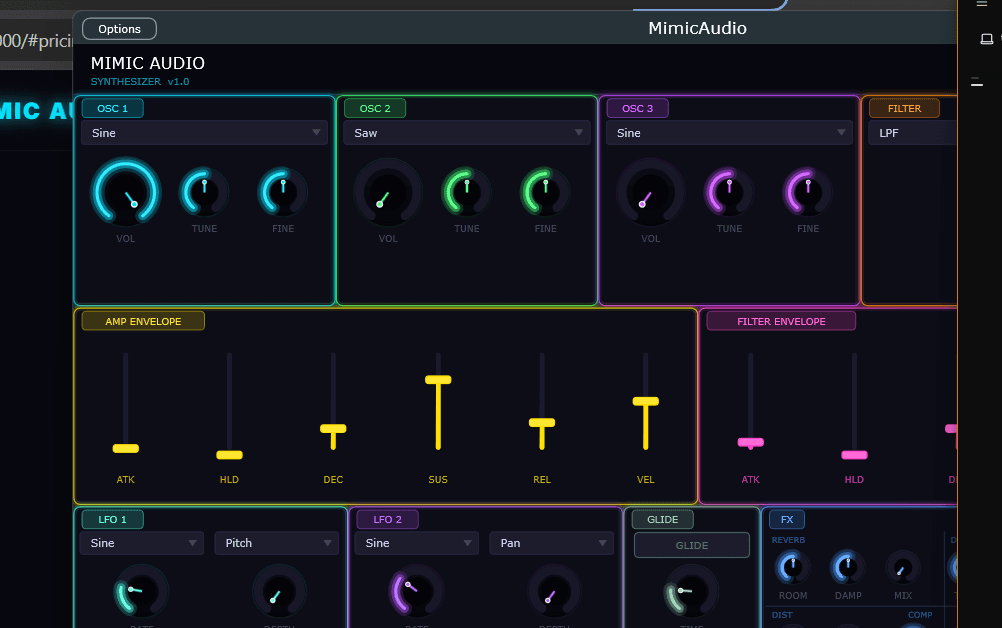
Load any candidate onto the engine and the source sound becomes a real, polyphonic instrument under your MIDI controller. 32 voices, multi-mode filters, full ADSR + modulation envelopes, 2 LFOs, complete effects chain — every parameter is automatable from your DAW.

› load patch · V2 Punchy Saw ...... OK
› 32 voices ready ................. OK
› MIDI controller bound ........... OK
Features

Built like real instrument software, not a generator gimmick.

Every detail that matters to a working producer or sound designer — and nothing that doesn't.

Real Multitimbral Synth

Three oscillators per voice, full waveform set, FM & AM modulation, sync — the engine isn't a sample player, it's a real subtractive + FM synthesizer.

Four Candidate Variations

Mimic doesn't lock you to one match. It generates four variations per query so you can pick the one that fits your track — or refine the best.

On-Device, On-Brand

Source separation and timbral inference run locally on your machine. No cloud upload of your work-in-progress tracks. No subscription gating.

Standard MIDI & Automation

Every synth parameter is automatable from your DAW. CC1 modulation, CC11 expression, full pitch-bend response. Plays nicely with your existing rig.

Effects That Earn Their Place

Reverb, delay, chorus, distortion (tube, tape, digital), compression, parametric EQ — chosen because producers actually reach for them, not to pad a spec sheet.

VST3 + Audio Unit, Mac & Windows

Works in Ableton Live, Logic Pro, FL Studio, Reaper, Bitwig, Studio One, and any other VST3/AU host. Both macOS (Apple Silicon + Intel) and Windows from day one.

Who it's for

Three workflows it just unlocks.

Mimic isn't aimed at everyone. It's built for the people who actually try to chase a specific sound and end up burning hours doing it the hard way.

For producers

"That bass from that song."

You know the sound. You can hear it. You've been digging through your sample library for an hour and nothing's it.

  • Drop the reference track in
  • Solo the bass stem
  • Load the closest variation onto your MIDI keys
  • Lay down your bassline in your own track — in 90 seconds
For sound designers

Faster blank-canvas escape.

Synthesizer presets are stale by their fifth user. Mimic's variations come from your reference — guaranteed unique starting points.

  • Feed any sound — a sample, a synth, a field recording
  • Mimic returns 4 distinct parameter sets
  • Tweak from there with full synth engine access
  • Save your version as a preset for next time
For film + game composers

Hit references without hiring.

Your director sent a temp track. They want "something like that". You don't have time to hire the original musician — and you don't need to.

  • Isolate the element they're referencing
  • Generate playable variations that capture the timbre
  • Perform it through your scoring template
  • Deliver on schedule, without the licensing
How it compares

The space between a separator and a synth.

Stem separators do half the job. AI synths do the other half. Mimic is the first plugin built to do both in one playable instrument.

Capability Stem Separators
AudioShake · LALAL · Demucs
AI Sound Designers
Synplant 2 · Riffusion
Mimic
This plugin
Separates a track into stems Yes No Yes
Turns a sound into a playable patch No Yes Yes
Works as a VST/AU plugin in your DAW Mostly online Yes Yes
Real synth engine you can tweak No Limited Full subtractive + FM
Runs on your machine (no cloud upload) Some yes Yes Yes
One workflow from source → playable No No Yes
Common questions

What you're probably wondering.

When does the shipping plugin land?+

The current build above is a v0.1 web concept demo — designed to prove the user flow end-to-end before native plugin engineering begins. The full VST/AU build is planned across three production phases (synth engine, AI timbral matching, polish + release). The roadmap targets a beta in roughly six months from kickoff.

What does the AI actually do?+

Two distinct AI stages. First, a stem-separation model (Demucs Hybrid Transformer) splits the source track into drums, bass, synth and vocals. Second, a custom timbral-inference model analyses the selected element and maps its spectral fingerprint to a candidate set of synthesizer parameters.

You're not getting an audio sample — you're getting a playable synthesizer patch tuned to match.

Will my audio be uploaded to a server?+

No. Both the separation model and the timbral inference run on your machine. Your work-in-progress audio never leaves your computer — important for film/game composers under NDA, and good practice for everyone else.

What DAWs and platforms are supported?+

Mimic ships as a VST3 and Audio Unit plugin on macOS (Apple Silicon + Intel) and Windows from v1.0. That covers Ableton Live, Logic Pro, FL Studio, Reaper, Bitwig, Studio One, Cubase, and any other VST3 or AU host. Pro Tools AAX support is on the roadmap for v1.1+.

Can it perfectly recreate any sound?+

No tool can. Mimic is a starting-point generator, not a perfect cloner. Vocals can't be turned into a playable vocal instrument (that's a different research problem). Hyper-specific human performance characteristics — breath, micro-timing, exact articulation — are out of scope for a synth-engine target.

What Mimic does well: capturing the timbre, character and tone of a sound so it sits in the same sonic space as the original.

How is this different from sampling?+

A sampler plays back a recorded audio file at different pitches. The result inherits artefacts of the source recording — room, key, transient. Mimic produces a real synthesizer patch tuned to match the timbral character. You play any note, any velocity, with no time-stretch artefacts and full control over every synth parameter.

What about licensing of the source material?+

Mimic doesn't reproduce or store the source audio in the output. The synth patches it generates are parameter sets — not recordings — and the resulting sound you perform is your own composition through your own MIDI input. As with any creative tool, you're responsible for using it within applicable copyright law in your jurisdiction.

Will pricing be subscription-based?+

No. Mimic v1.0 will be a one-time purchase. Pricing is to be confirmed at launch — sign up for early access below and you'll get launch-window pricing plus founder-supporter perks.

Build roadmap

Where we are. Where we're going.

Mimic is being built in four sequential phases. Each phase ships a real, tested deliverable before the next phase begins — no perpetual pre-order in the dark.

STAGE 01 · COMPLETE

Concept & Demo

Public web demo proving the full source-to-playable user flow. UI/UX language locked. Architecture and stem-separation model validated.

SHIPPED · Jun 2026
STAGE 02 · IN PROGRESS

AI Timbral Engine

Custom neural model that maps a target sound's spectral fingerprint into our synthesizer's parameter space. Four candidate patches per query, refinement loop, full evaluation harness.

DELIVERY · Oct 2026
STAGE 03 · PLANNED

Synth + Plugin Shell

Full multitimbral synth in JUCE/C++: oscillators, filters, envelopes, LFOs, effects. VST3 + Audio Unit shell with AI parameter binding. Closed alpha with founding subscribers.

DELIVERY · Jan 2027
STAGE 04 · PLANNED

Polish · Beta · v1.0

Final UI per design brief, preset manager, copy-protection, signed installers for macOS and Windows. Open beta, bug-fix sprint, public release.

RELEASE · Q3 2027
Early access

Be in the room when v1.0 ships.

Subscribers get launch-window pricing, founder-supporter perks, and the closed beta a month before public release. No spam — one email per real milestone.

No spam · unsubscribe in one click · GDPR-friendly
Patch loaded.